
Technological innovations play a crucial role in the development of tourism: they simplify work processes, improve service quality, and make travel more comfortable for customers. Information technology in the tourism industry promotes business growth, enhances service, and accelerates adaptation to market changes. For organizations to operate effectively, it is important to consider current digital trends and implement modern solutions. This article examines the main areas of digital development for travel.
Modern information technologies in tourism
Below are the most in-demand digital solutions.
1. Environmental initiatives
Modern developments are increasingly focused on reducing the negative impact on the environment:
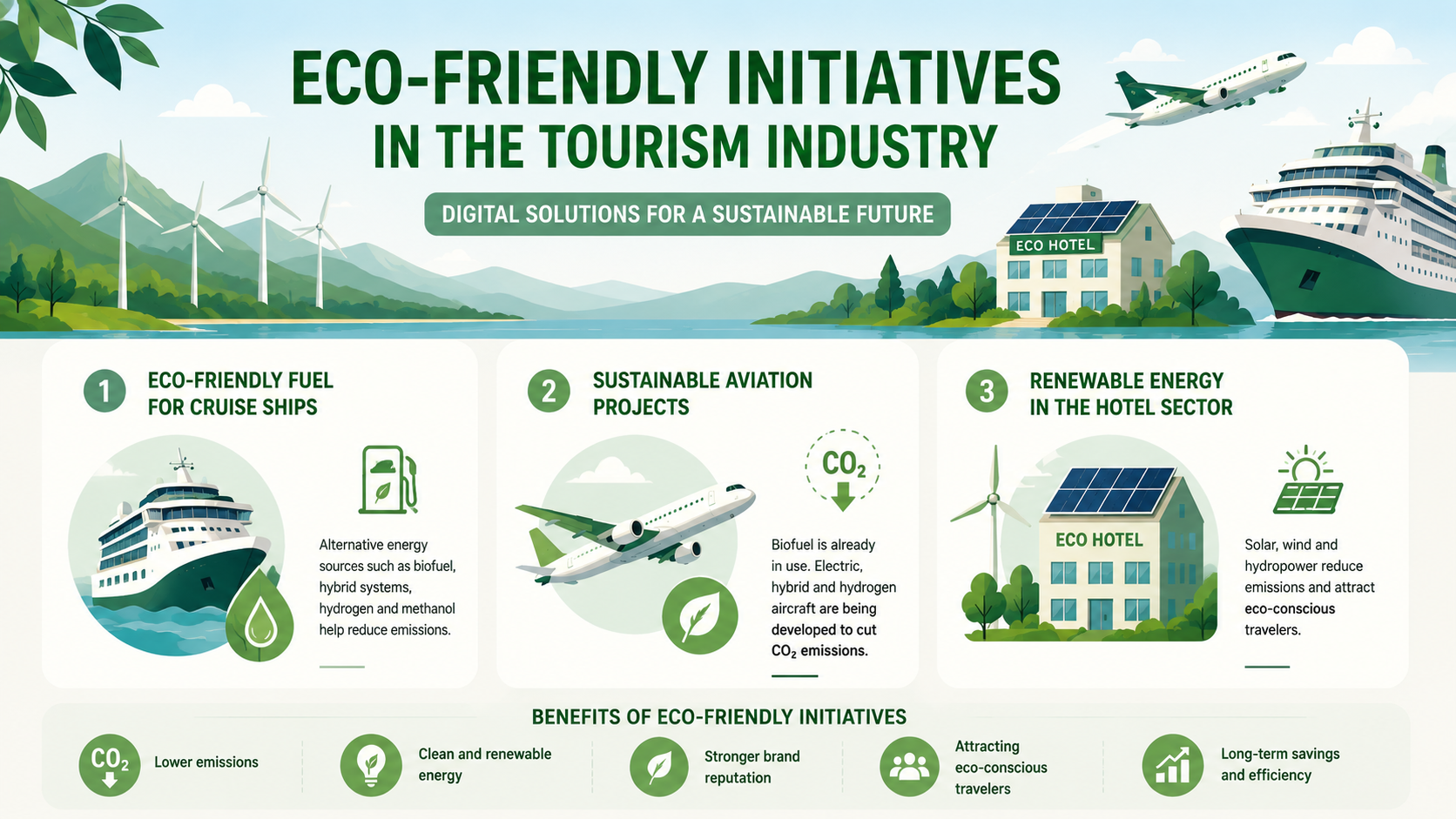
- Eco-friendly fuel for cruise ships. In the cruise sector, alternative energy sources, including biofuels and hybrid power systems, are gradually becoming more common. Hydrogen and methanol are also being considered as promising options for reducing emissions.
- Environmental projects in aviation. Airlines are implementing new environmental approaches in response to passenger demand and international requirements. As of 2022, aviation accounted for about 2% of global CO₂ emissions. Today, some aircraft already use biofuel, and engineers continue to develop electric, hybrid, and hydrogen-powered planes.
- Renewable energy in the hotel sector. Major hotel chains are transitioning to solar, wind, and hydropower. Despite significant initial investments, brands like Hilton, Marriott, and Accor are investing in environmental projects to reduce emissions and attract tourists who prefer eco-friendly travel. For example, The Hotel Marcel, a Hilton property, is fully powered by solar panels.
2. Artificial intelligence (AI)
Artificial intelligence is being more actively integrated into the travel industry. Information technology in tourism makes it possible to automate customer service and improve service quality. AI has been incorporated into chatbots that promptly respond to user inquiries. Additionally, hotels and travel companies use intelligent algorithms to process information, analyze performance metrics, and allocate resources.
3. Big data
Big data analytics holds a significant place in the tourism sector. Companies use it to study audience preferences, create personalized offers, and evaluate business performance. For example, hotels use analytics platforms to forecast demand and adjust accommodation prices.
4. Blockchain
Blockchain is a decentralized system for storing information, ensuring transparency and security of transactions. Tourism and information technology are closely linked with blockchain, as this approach protects customers and simplifies financial transactions.
5. Robotics
Automated devices are increasingly finding applications in the travel industry. In hotels, robots perform the functions of concierges, luggage carriers, and cleaning staff. In food service establishments, similar devices assist in food preparation, and in airports, they are used to ensure passenger safety. The adoption of such technologies became particularly active during the COVID-19 pandemic.
6. Voice search and control
Voice search is increasingly used for selecting and booking travel services, so website owners have to adapt their online resources for such queries. In hotel rooms, voice control systems are used to adjust lighting, air temperature, and obtain necessary information, making guests’ stays more comfortable.
7. Augmented reality (AR)
Augmented reality adds digital elements to the surrounding environment using a smartphone or tablet. In the tourism sector, such solutions are used for navigation, providing reference data, and organizing interactive entertainment.
8. Virtual reality (VR)
Virtual reality allows you to preview a vacation spot without leaving home, which can influence the decision to book a trip. Virtual tours of hotels, restaurants, and attractions, accessible through a browser, become an additional advantage for businesses.
9. Internet of things (IoT)
The Internet of Things is a network of interconnected devices that exchange data with each other. In hotels, such systems are used for centralized management of equipment and services. At airports, special sensors allow passengers to track the location of their luggage.
10. AI-powered chatbots
Chatbots with artificial intelligence elements provide round-the-clock user support and allow for quick resolution of standard questions. They are especially popular in the hotel industry, where guests often ask for information about Wi-Fi, the operating hours of various facilities, and available services. The use of such services helps improve service quality and increase companies’ profits.