

In today’s digital world, Application Programming Interfaces (APIs) are the backbone of modern backend development. They enable different software systems to communicate, ensuring seamless data flow across various applications. This article explores the role of APIs in backend development, discusses different API types, and reviews popular frameworks for creating them.
What is an API and why is it important?
An API is a set of rules that lets software applications communicate. It specifies how software components should interact. In backend development, APIs are crucial because they allow other applications to consume services, whether on the same platform or different devices.
APIs have many roles, from retrieving data and handling user authentication to facilitating communication between microservices. They abstract the underlying system’s complexity, allowing front-end applications or external services to interact with the backend in a structured, predictable way.
Types of APIs in backend development
There are several types of APIs used in backend development. Here are the three most common:
1. REST APIs (Representational State Transfer)
REST APIs are the most widely used in modern web development. They follow principles like statelessness and a client-server architecture, where the backend and front-end communicate via HTTP requests. RESTful APIs let backend systems expose resources—like user data—over standard HTTP methods (GET, POST, PUT, DELETE). Their flexibility and scalability make them a preferred choice for most backend frameworks.

2. GraphQL APIs
GraphQL is a flexible alternative to REST. Unlike REST, which may require multiple requests for related data, GraphQL allows clients to request exactly what they need in a single query. This reduces requests and improves performance, especially on slow networks. Backend developers can define a single endpoint that exposes the application’s data schema, which is useful for managing real-time data or complex relationships.
3. WebSocket APIs
While REST and GraphQL use request-response communication, WebSocket APIs enable bi-directional, real-time communication between a client and server. This is ideal for applications requiring live updates, like chat apps or online gaming. With WebSockets, the server and client maintain a persistent connection, allowing either party to send data without re-establishing a connection, which is crucial for speed and low latency.
Best practices for API design
To ensure your API performs well, follow these best practices:
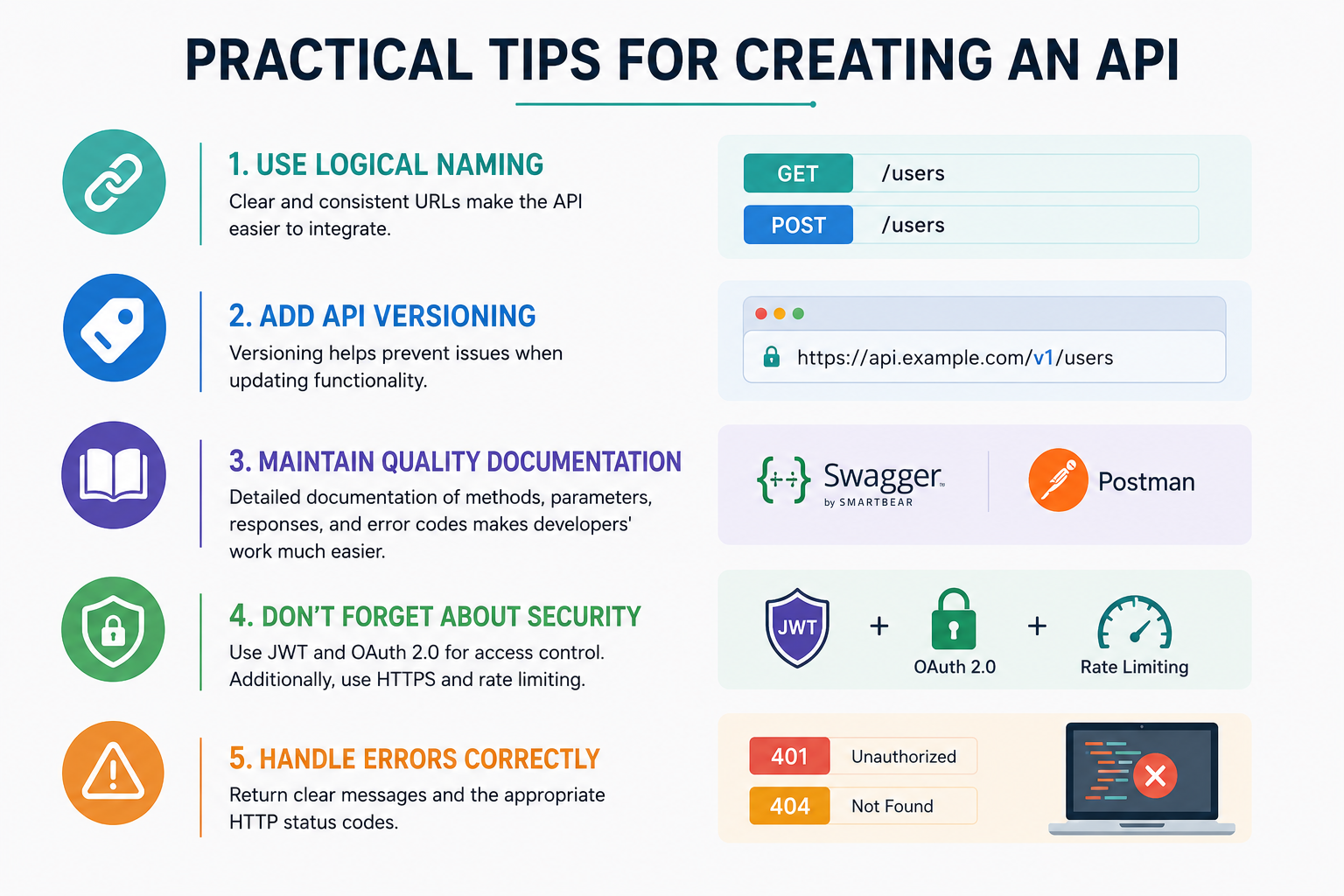
- Use clear naming conventions: Consistent naming for endpoints and resources makes an API intuitive (e.g., GET /users, POST /users).
- Version your API: As your API evolves, versioning prevents changes from breaking existing client integrations. A common approach is using a URL path (/v1/users).
- Document your API: Clear documentation is crucial. Tools like Swagger or Postman can help explain endpoints, request/response structures, and error messages.
- Implement security: Authentication and authorization are critical. Use methods like OAuth2 or JSON Web Tokens (JWT) to protect your API from unauthorized access. Rate limiting and HTTPS add further security.
- Handle errors gracefully: Return clear error messages with proper HTTP status codes, such as 404 Not Found or 401 Unauthorized.
Popular backend frameworks for building APIs
The right backend framework simplifies API development. The choice depends on the language, complexity, and scalability needs. Here are some popular options:
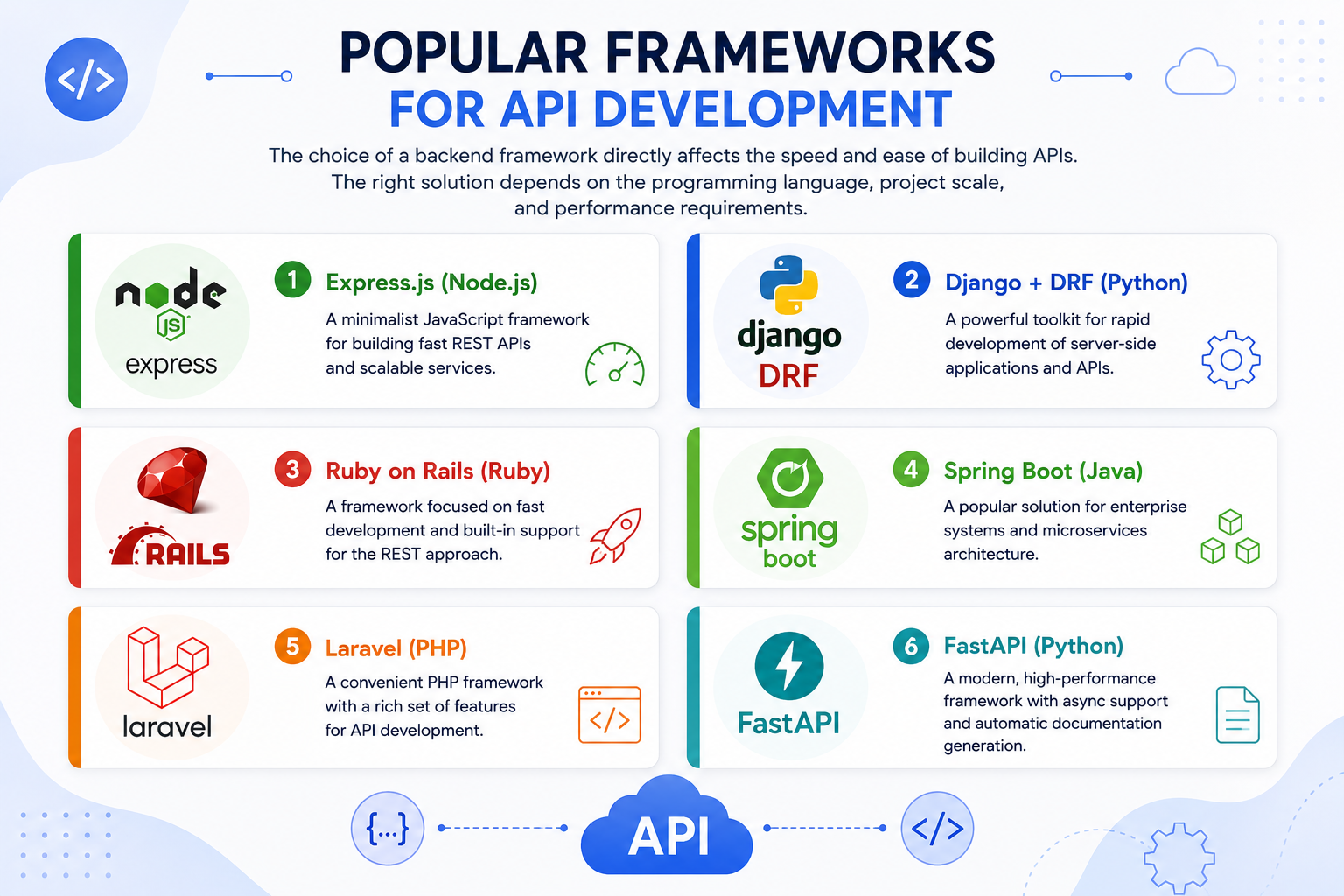
- js (Express.js): A lightweight JavaScript framework for building fast, scalable RESTful APIs.
- Django (Python): A high-level Python framework that speeds up API development, often used with the Django REST Framework (DRF).
- Ruby on Rails (Ruby): Known for rapid development and its convention-over-configuration philosophy, with built-in tools for creating RESTful APIs.
- Spring Boot (Java): A Java-based framework for building production-ready, microservices-based applications.
- Laravel (PHP): A PHP framework with powerful built-in features for building REST APIs.
- FastAPI (Python): A modern, high-performance Python framework that supports asynchronous programming and provides automatic documentation.