

The modern labor market is changing rapidly, and more specialists are choosing remote employment. This trend is especially noticeable in the digital sector, where many tasks can be performed from home without any loss of efficiency. That’s why remote work in information technology is becoming increasingly popular among job seekers and employers.
Companies are actively developing online services, automating internal processes, and implementing new digital solutions. Supporting these systems requires qualified employees who can work remotely and adapt quickly to new tasks.
Working in information technology from home
Most processes in IT have long been organized over the internet. Software development, service testing, server administration, and data analysis don’t require a constant presence in the office. As a result, remote work in IT has become a familiar format for thousands of specialists.
For collaboration, employees use corporate messengers, video calls, task management systems, and cloud platforms. This allows teams to work effectively even when located in different cities and countries.
Additionally, the remote format helps save time, plan the day flexibly, and choose jobs without being tied to a specific location.
Which specialists are in demand
The demand for IT professionals remains high in both large companies and small projects. Employers are especially active in seeking specialists in the following areas:
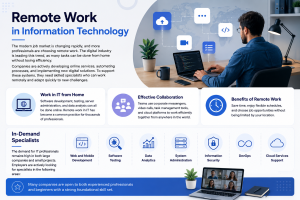
- Website and mobile application development.
- Software testing.
- Data analytics.
- System administration.
- Information security.
- DevOps.
- Cloud services support.
Many companies are willing to consider not only experienced employees but also entry-level specialists with good foundational training.
How to start a career in IT
You don’t necessarily need a specialized higher education to enter the profession. In IT, practical skills, problem-solving abilities, and a willingness to learn continuously are highly valued.
You can master a high-demand specialty in several ways:
- Take online courses.
- Study materials independently.
- Participate in internships.
- Work on educational and real projects.
- Obtain professional certifications.
Employers often pay attention to a candidate’s portfolio and level of practical training.

What skills are important for successful work
To succeed in IT, you need not only to understand technology but also to organize your work competently.
The most valued skills are:
- Analytical thinking.
- Attention to detail.
- Ability to learn quickly.
- Effective communication.
- Discipline.
- Responsibility.
- Time management skills.
In a remote format, it’s important for an employee to maintain productivity without constant supervision from a manager.
Popular professions in IT
Today, remote information technology jobs are available for specialists in various fields.
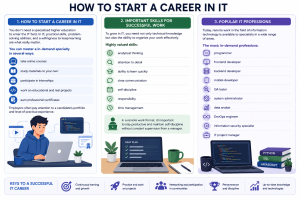
The most in-demand roles are:
- Programmer.
- Frontend developer.
- Backend developer.
- Mobile developer.
- QA tester.
- System administrator.
- Data analyst.
- DevOps engineer.
- Information security specialist.
- IT project manager.
The salary level depends on experience, the complexity of tasks, and the technologies used.
How much can you earn
The IT field is considered one of the most promising in terms of income. Even entry-level specialists can expect a competitive salary.
On average in the market:
- Junior employees earn from $1,000.
- Specialists with experience earn from $2,500.
- Experts in complex technical fields earn from $5,000 and up.
The highest salaries are usually offered by large technology companies and international projects.
Where to look for jobs
You can find a suitable job on major job search websites, specialized IT platforms, and in professional communities.
Popular resources for job searching:
- LinkedIn.
- Indeed.
- Glassdoor.
- Company career pages.
- AngelList (for startups).
When searching, it’s convenient to use filters for experience, specialization, and employment format.