

The pace of technological change has always been fast. For example, in late 2019, the e-commerce market grew as much in just three months as it would have in ten years under normal conditions. Projections suggest that humanity will see more progress in the next decade than in the last hundred years. That’s why trends in information technology are becoming a crucial guide for business and society.
Most likely, they will shape the modern workspace in the coming years. Understanding their impact on companies and the labor market will help us successfully adapt to future changes.
Top trends in information technology
Below are 10 key areas to watch right now.
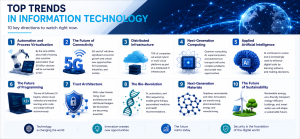
1. Process automation and virtualization
Modern processes are poised to replace about half of all existing job types in the coming years.
It’s projected that over 50 billion devices will be connected to the Industrial Internet of Things (IIoT). Robotics, automation, and 3D printing will generate about 79.4 zettabytes of data annually.
2. The future of connectivity
Faster digital networks based on 5G and the Internet of Things (IoT) have the potential to drive massive economic growth. These new developments in information technology open up additional opportunities for business, industry, and the social sphere.
3. Distributed infrastructure
Forecasts suggest that 70% of companies will adopt hybrid or multi-cloud platforms as part of a distributed IT infrastructure. This will enable faster data processing and provide convenient access from various devices.
This approach will help businesses increase flexibility and speed, reduce complexity and costs, and strengthen cybersecurity.
4. Next-generation computing
Next-gen computing will help solve complex scientific and societal problems while creating opportunities for entrepreneurs. New trends in information technology are closely linked to the development of quantum computing, artificial intelligence, supercomputers, and fully autonomous vehicles.
Preparing for this transition requires understanding whether your company is in a “first wave” industry — like finance, tourism, or logistics.
5. Applied artificial intelligence
Artificial intelligence remains one of the most significant trends, yet it is still in a phase of active development. As AI improves, it is being used more widely to enhance digital tools — for example, to train systems to recognize patterns and make decisions based on them.
6. The future of programming
We are entering the era of Software 2.0, where neural networks and machine learning will be able to write code and create software on their own. The latest technological trends in IT show that artificial intelligence is becoming a critical tool for developing digital solutions and automating processes.
7. Trust architecture
In 2019, over 8.5 billion data records were compromised. Despite the evolution of cybersecurity systems, the number of cyber threats continues to grow. This is why trust architectures are becoming one of the most important areas in IT.
One key solution is the use of distributed ledgers, including blockchain. It helps lower security compliance costs, reduce operational and capital expenses related to data protection, and make digital transactions more reliable and cost-effective.
8. The bio-revolution
Modern advances in the biological sciences could seriously impact both the economy and people’s daily lives, affecting industries from medicine to energy.
AI, automation, and DNA sequencing are opening up possibilities for gene therapy, personalized medicine, and health recommendations based on genetic data.
9. Next-generation materials
Advances in materials science have the potential to transform the pharmaceutical, energy, and manufacturing industries. Special attention is being paid to materials like graphene, which is about 200 times stronger than steel and highly conductive, as well as molybdenum disulfide nanoparticles used in flexible electronics.
10. The future of green tech
Modern trends are focused on the development of renewable energy, green transportation, energy-efficient buildings, and sustainable water resource management. As these technologies become cheaper, their adoption will only accelerate and expand across more industries.